
 0440 132 640


LDV DPF Blockage – Heavy Smoke, P2463 Codes & What It Really Means
LDV showing P2463 DPF fault and heavy exhaust smoke? Here’s what causes soot overload, why regeneration fails, and what actually needs to be fixed.
This LDV came in with a clear and advanced DPF issue, and straight away it wasn’t one of those early-stage faults you sometimes catch before they become a problem.
On arrival, the vehicle was producing visible smoke from the exhaust, even at idle. That’s already a strong indicator that the DPF system is no longer functioning as intended. At this point, you’re not dealing with a minor soot build-up — you’re dealing with a system that has lost control of the regeneration process.
Initial symptoms observed
The most obvious symptom was the consistent exhaust smoke. This wasn’t light condensation or a cold-start haze — it was steady and noticeable, pointing toward particulate matter bypassing or overwhelming the filter.
In a correctly operating DPF system, you should not see this. The entire purpose of the filter is to trap soot and burn it off during regeneration. So when smoke is visible, it tells you something has gone wrong beyond normal operating limits.
Fault codes retrieved
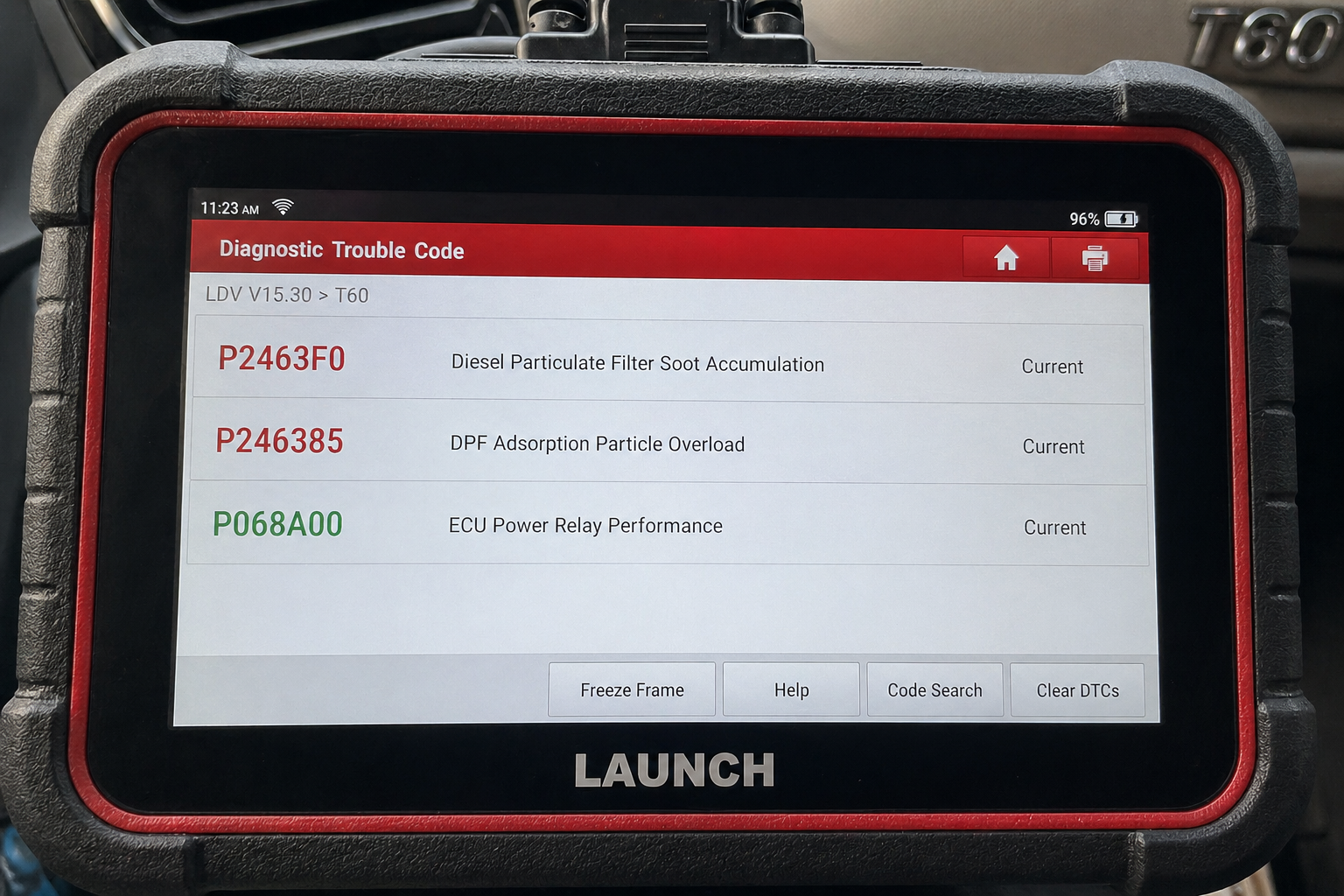
A full diagnostic scan revealed the following codes:
P2463F0 – Diesel Particulate Filter soot accumulation P246385 – DPF adsorption particle overload P068A00 – ECU power relay performance fault
The two P2463 variants are the key here. These indicate that the DPF has reached a critical soot load condition. The ECU is effectively flagging that it can no longer manage soot levels through normal regeneration.
The additional P068A00 code relates to ECU power supply performance. While not a direct DPF fault, it can influence system stability and should be considered during diagnosis.
What these codes mean in real terms
A lot of people see P2463 and immediately assume the DPF is blocked and just needs a clean. That’s only part of the story.
What these codes are really telling you is that the vehicle has had multiple failed or incomplete regeneration cycles. Soot levels have continued to rise beyond normal limits, and the system has now reached a point where automatic recovery is no longer possible.
At this stage, the vehicle will not fix itself with normal driving. The DPF is overloaded and requires proper intervention.
Why the smoke matters
The visible smoke is a key detail in this case.
A DPF that is functioning correctly will trap soot particles and prevent them from exiting the exhaust. When you see smoke, the filter is no longer effectively containing particulate, exhaust flow and filtration are compromised, and the system is operating outside of its designed parameters.
This confirms the issue is advanced, not just an early warning stage.
What typically leads to this condition
On LDV vehicles, this type of fault usually builds over time rather than happening suddenly.
Common contributing factors include repeated short trips preventing proper regeneration, interrupted or failed regeneration cycles, gradual soot accumulation exceeding burn-off capability, and underlying issues affecting combustion or airflow.
Once the system falls behind on regeneration, it becomes a compounding issue. Each failed regeneration increases soot load until the ECU flags a critical condition.
Why proper diagnosis matters
At this stage, simply clearing codes or attempting a basic regeneration is not enough.
A proper diagnostic process involves confirming soot load levels, checking exhaust pressure readings, verifying sensor accuracy and operation, and identifying why regeneration has stopped working.
If the root cause isn’t addressed, the DPF will continue to overload again even after cleaning.
What happens if it’s ignored
Leaving a vehicle in this condition can lead to increased exhaust restriction, reduced engine performance, limp mode activation, increased fuel consumption, and further mechanical stress.
Eventually, it can result in a complete blockage requiring more extensive repair.
The correct way forward
For a case like this, the process is a full diagnostic assessment, identifying and resolving the cause of failed regeneration, carrying out a DPF clean if the filter is still serviceable, performing a controlled regeneration, and re-checking system operation to confirm stability.
This ensures the issue is resolved properly, not temporarily masked.
Final thoughts
When an LDV is showing multiple P2463-related codes and producing visible exhaust smoke, it’s already well beyond early warning stages.
The key takeaway is simple. It’s not just about cleaning the DPF — it’s about understanding why it got to this point in the first place. Getting that right is what stops the problem from coming straight back.
Need help with an LDV DPF issue?
If your vehicle is showing P2463 codes or producing smoke, it’s best to have it properly diagnosed before it worsens. Mobile diagnostic and DPF services available — get in touch to book.